
THE CHINESE ANTONIANS OF THE 1950s & 1960s
The arrival of the Chinese descent students at St Anthony's College was a welcome and notable event in the school’s history. The first of the era were Hi Aun (HA) Ching and Vin Aun (VA) Ching, followed by their cousins Win Chu Wei and Chan Fa Ching. Trevor Berenger takes a look down memory lane on their journey…
by TREVOR BERENGER
BACKGROUND**
The Chinese Diaspora, i.e., the dispersal of Chinese people, from their homeland to other parts of the planet, has been going on for centuries. The vast majority of these people moved to neighbouring countries, and their influence has been huge in Singapore, Thailand,Indonesia Malaysia and Phillipines, where they number in the multiple millions.
By comparison, only a trickle reached Sri Lanka. Over the centuries, the pattern has been for the Chinese descendants to quickly integrate with the local population, mainly the Sinhalese. The boys who entered the school, were therfore descended from recent arrivals, because they were not of mixed blood.
It is an interesting fact that the last Imperial Dynasty of China was the Qing(Ching) Dynasty, 1644 to 1911. Founded by invading Manchus from the North, adding another layer to China's core ethnic group of Han.
Ching is a surname of people from North China. The northern coastal provinces of Hebei and Shandong are probably the original home of most of the Anthonian Chinese. The impetus to move would likely have been the Civil war (1927-1945),or perhaps the Japanese Invasion of China (1937 -1945), and the need to escape the ravages of those events. Or, possibly, they continued to Colonial Ceylon moving on from their earlier migrations to Southeast Asia, looking for better opportunities.
**The above is based upon information available on the internet, including Wikipedia
Whatever the case, their arrival at St Anthony's College was a welcome and notable event in the school's history.
The first Chinese descent students of the era were Hi Aun (HA) Ching and Vin Aun (VA) Ching, they would have enrolled about 1950, had their schooling throughout the decade until they entered the University of Ceylon at Peradeniya. HA Ching, the elder brother, would have entered the Dental faculty at Peradeniya about 1958 or 1959 and VA Chang, the Veterinary Faculty a year or so after the elder brother. The numbers admitted to the Universities in those days were extremely limited, but there was little doubt the Ching brothers would qualify, as their academic potential was on regular display at the Annual school Prize Givings, as they collected multiple prizes.
The family lived in the Tennekumbura area along the road from Kandy to Kundasale, just a little way from Dharmaraja College. Although this meant an energy-sapping daily commute, both Ching brothers participated in the school’s extracurricular activities. Both played cricket as opening batsmen, not the easiest place to bat. HA Ching played up to Second Eleven and VA Ching played First Eleven, quite remarkable given cricket was an alien game for Chinese people and also because this period, the fifties, is regarded as the Golden Age of Anthonian Cricket and the competition for places was strong.
A feature of the cricketing Chings, was that they wore Khaki coloured Pith Helmets when batting. In the days before Helmets came into use, this afforded a measure of protection against short pitched bowling. Although not unique, this kind of headgear was not worn by most cricketers and probably reflects the pragmatic Chinese mind at work, either with the boys or their parents.
HA Ching
The elder brother, HA Ching, was one of the pioneers of Anthonian Rugby and played in the first ever team fielded by St Anthony's, in 1956 or possibly 1957, which was captained by Bruce Winter. I am fairly sure that the brothers were also in the Cadet Corp. Which, again, was of a piece with their characters.
HA Ching was designated Sergeant to Camp at the Annual Cadet Camp at Diyatalawa. His brother, VA Ching was given the same special position in the next year and my good friend and classmate, Mark Schrader followed thereafter.
On Graduation, HA Ching embarked on a long career as a Dental Surgeon, with his practice located in Hatton. He was married to a Pau (or Pao) and had a few children, not sure how many, and the family have gradually relocated to Australia. In HA Ching’s case, after his retirement a few years ago.
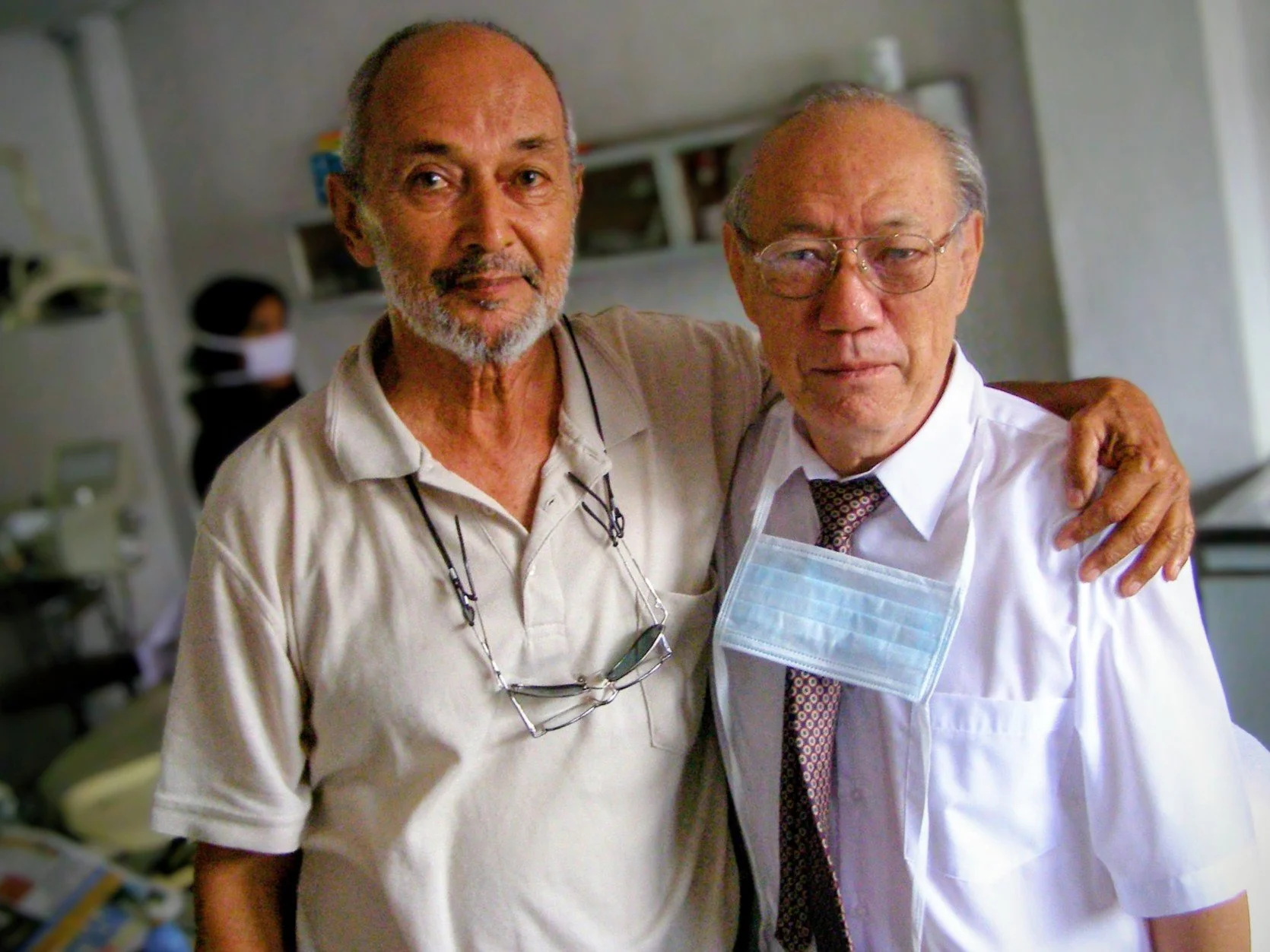
The photograph below shows HA Ching at his Hatton Practice with a contemporary, Winston Bayley. It was very late in his career and Winston reports that it was a very emotional meeting with the odd tear or two being shed! The Bayleys were a Plantation family and Winston's mother was one of the first patients at VA Ching's Clinic in Hatton.
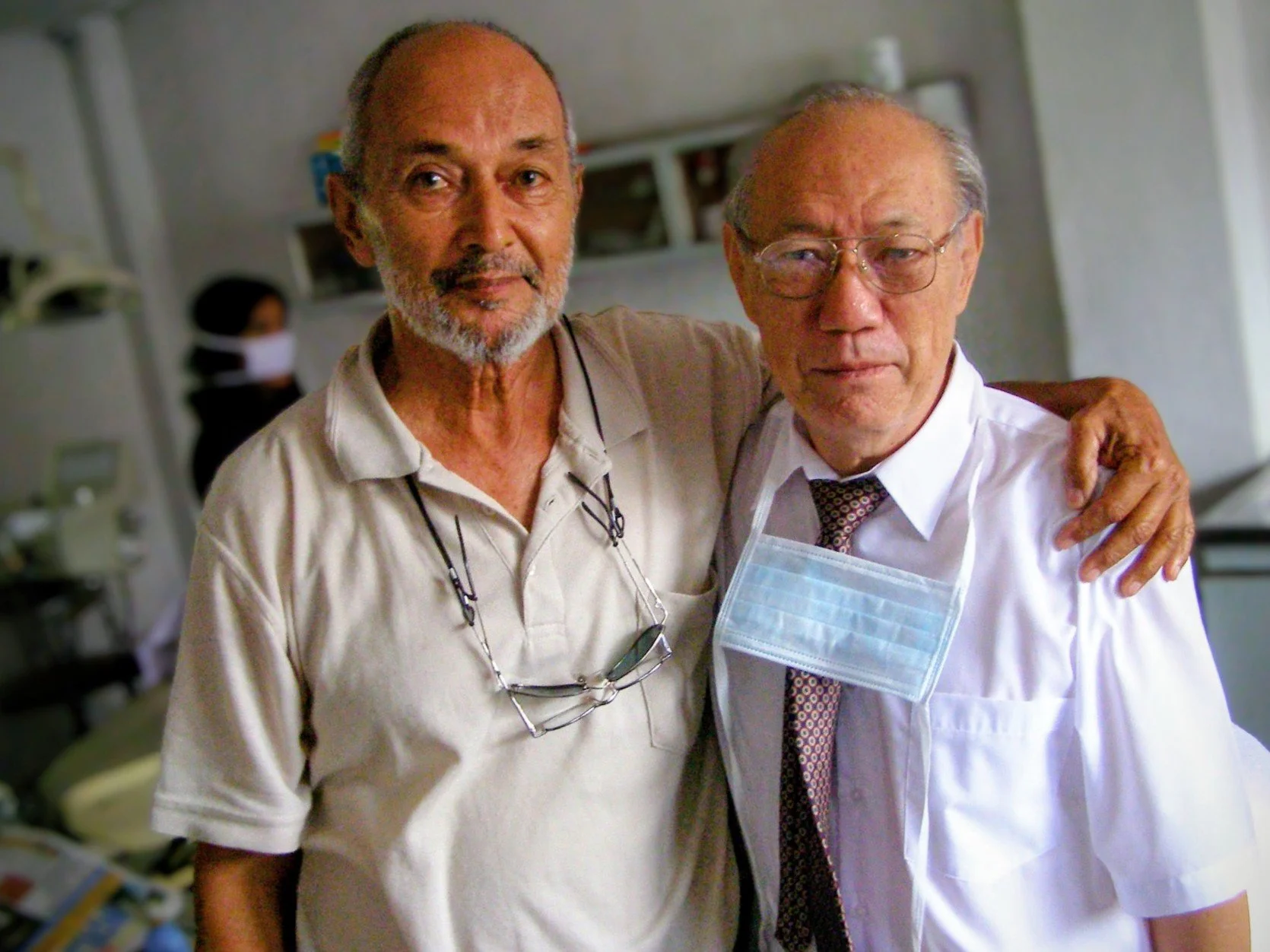
HA Ching with Winston Bayley in the Clinic at Hatton.
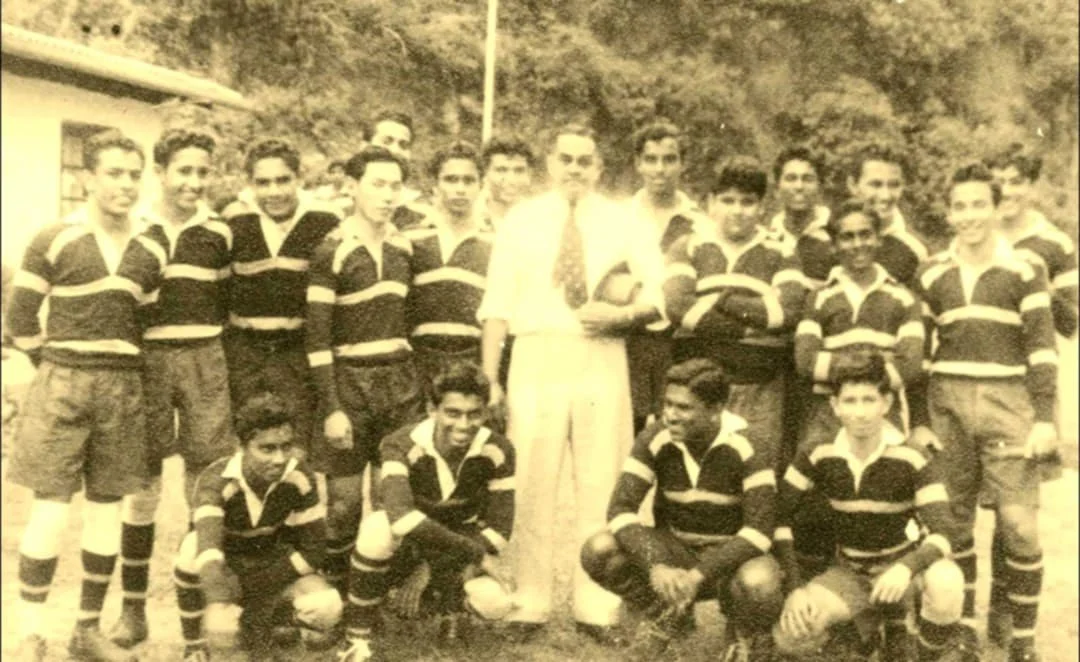
HA Ching is seen here standing 4th from left. Bruce Winter is behind the coaches right shoulder.
VA Ching
VA Ching graduated as a Veterinary Surgeon. His classmate, Steve Morrell writes: He was practicing, at Colombo 5, forget the address; Eric L(abrooy), used to tell him in jest, 'adai, you would say, hello doggy, and kill all the dogs that come to you', he was a successful Vet Sur.
He was in our class, form all, he was told to make a speech about his country, he said 'I have many friends, when I go to China, I will bring back toys for them'. It took him a long time to live that down.
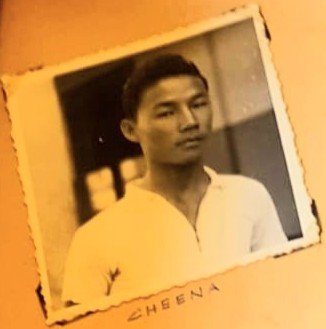
VA Ching in his schooldays at St Anthony’s in the 1950's. Note someone's cheeky "Cheena" comment!
Win Chu Wei
Win Chu Wei was the next to enter the College; he arrived about 1955. He was a cousin of the Chings and was well-liked by his peers, being a very amiable fellow. Although he did not proceed to higher studies, a couple of his classmates I have spoken to, Monte Holsinger and my brother Patrick Berenger, say he was highly intelligent. Powerfully built, he excelled in sports with his main accomplishments being in Rugby, where he represented the First XV, captaining St Anthony's in 1961 and 1962. He also played some Club Rugby. Win Chu Wei was also a sprinter of note, representing the College in the short sprints and relay team in the Central Province and Public Schools Athletic Championships.
The family owned a shop in Kandy Town called "Shoppe de Shoe" and Win Chu was involved with it for a few years after leaving school. Later, he set up a manufacturing operation in the Colombo Free Trade Zone, producing rubber soles, with the biggest customer being the Bata Shoe Company in Colombo.
The sixties and seventies were not the best time to operate a business, with all sorts of obstacles, including severe exchange rate restrictions, Bureaucratic red tape, plus, Civil war!
He migrated to Toronto, Canada, with his family, where he sadly passed away at a relatively early age.
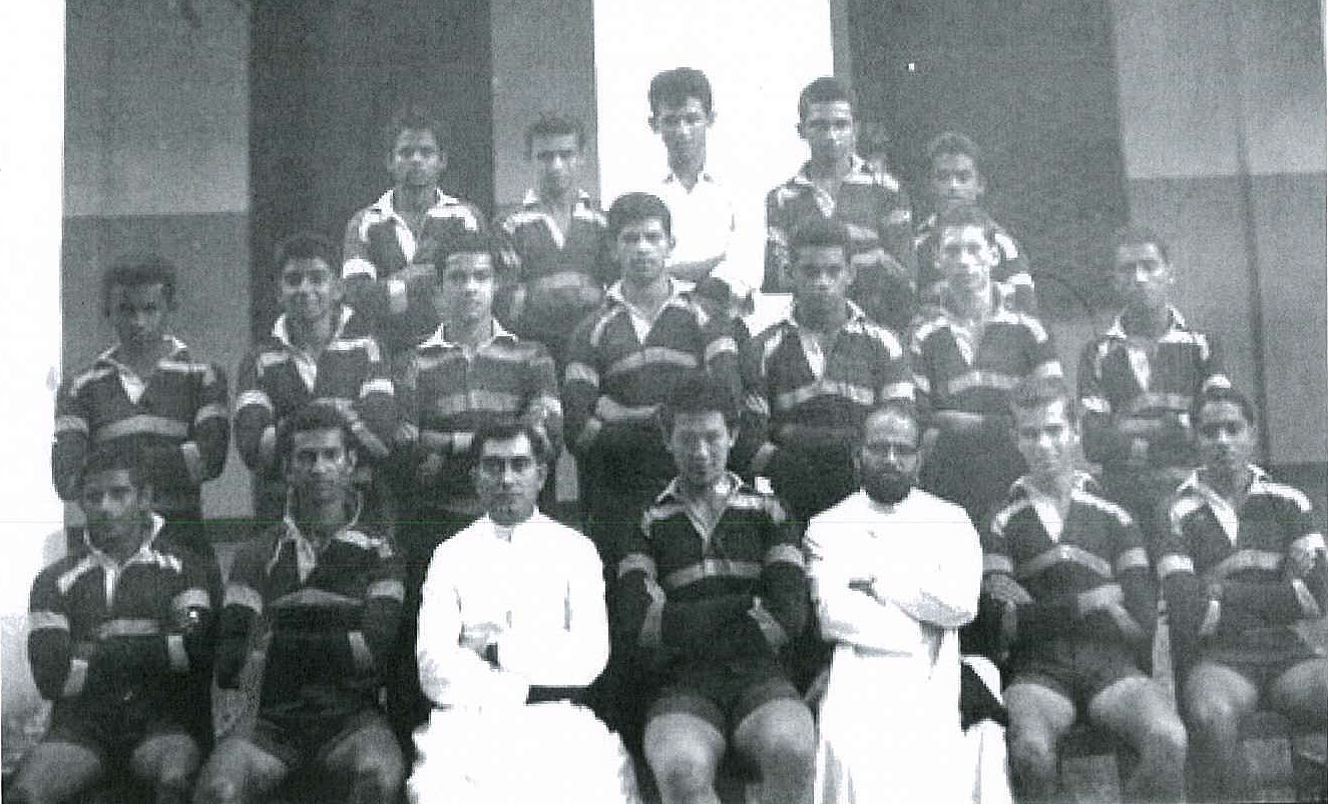
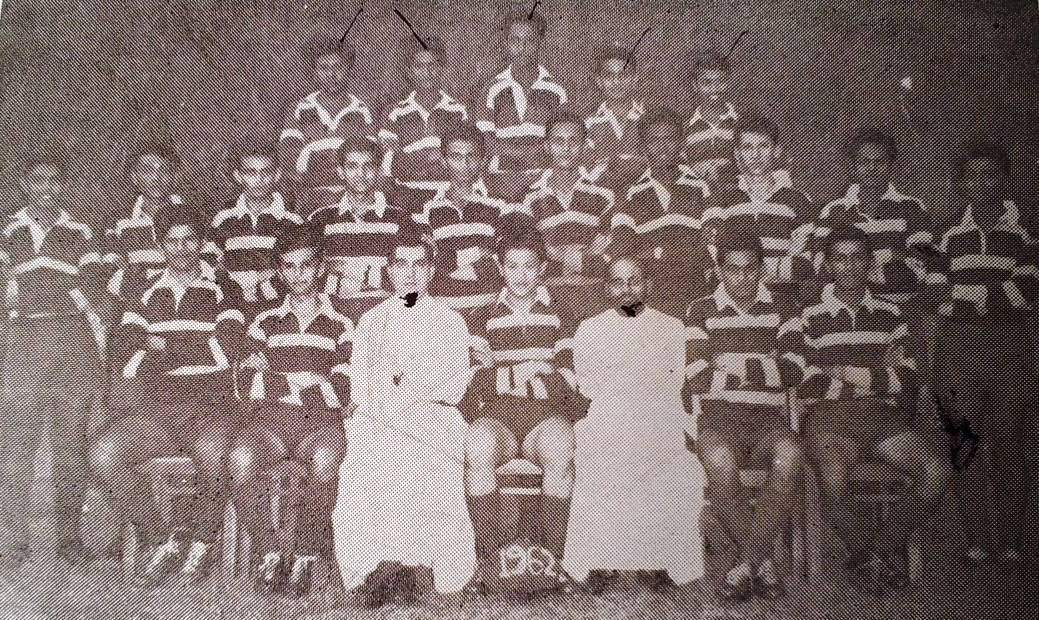
Antonian rugby sides from 1961 (above) and 1962 (below) - both captained by Win Chu Wei, who is seated in the middle.
Chan Fa Ching
Chan Fa Ching, a cousin of Win Chu Wei, attended College during 1955-66. While still in College he played for Kandy Sports Club in 1966 and continued till 1970. He has the unique distinction of being one of the first Anthonians to play Rugby for Ceylon, in 1968.
After school, Chan Fa followed in the Ching tradition as a Dental Mechanic in Nawalapitiya, for a while. He then joined his Cousin Win Chu Wei in the Rubber Sole manufacturing business mentioned earlier.
Chan Fa still resides in Sri Lanka.
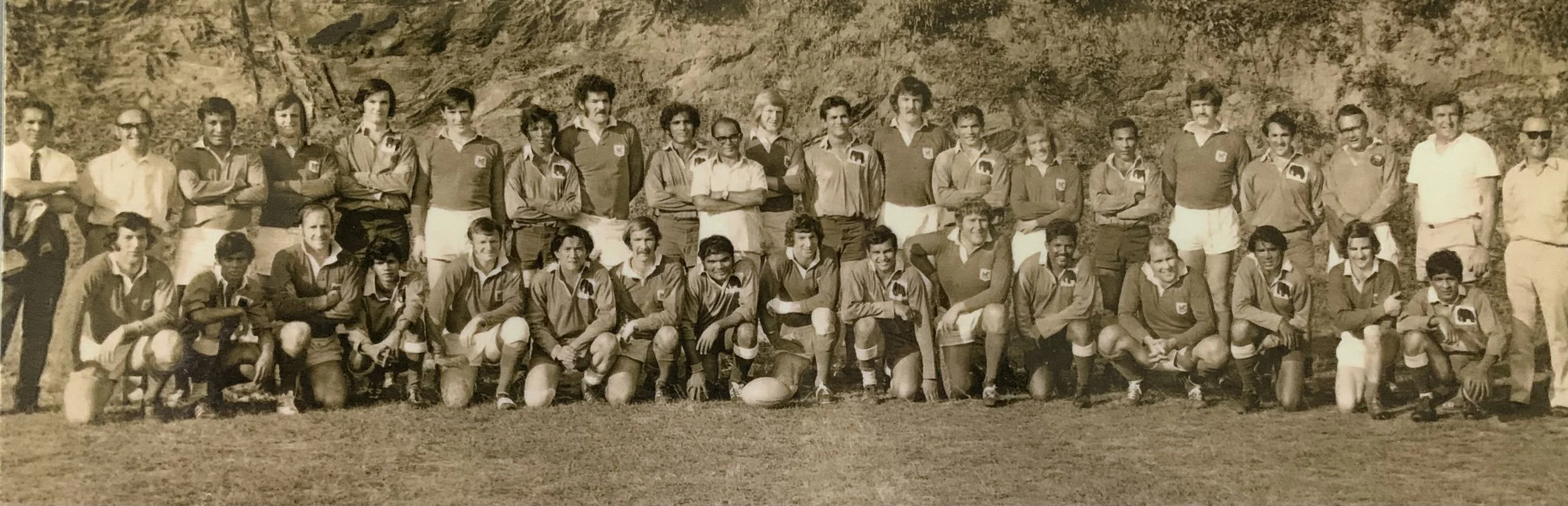
Chan Fa - bottom row 6th from the left, when he played for Ceylon against the British Lions in Ceylon. The other Antonian in the Ceylon team is Gavin Stevens squatting 8th from the left.
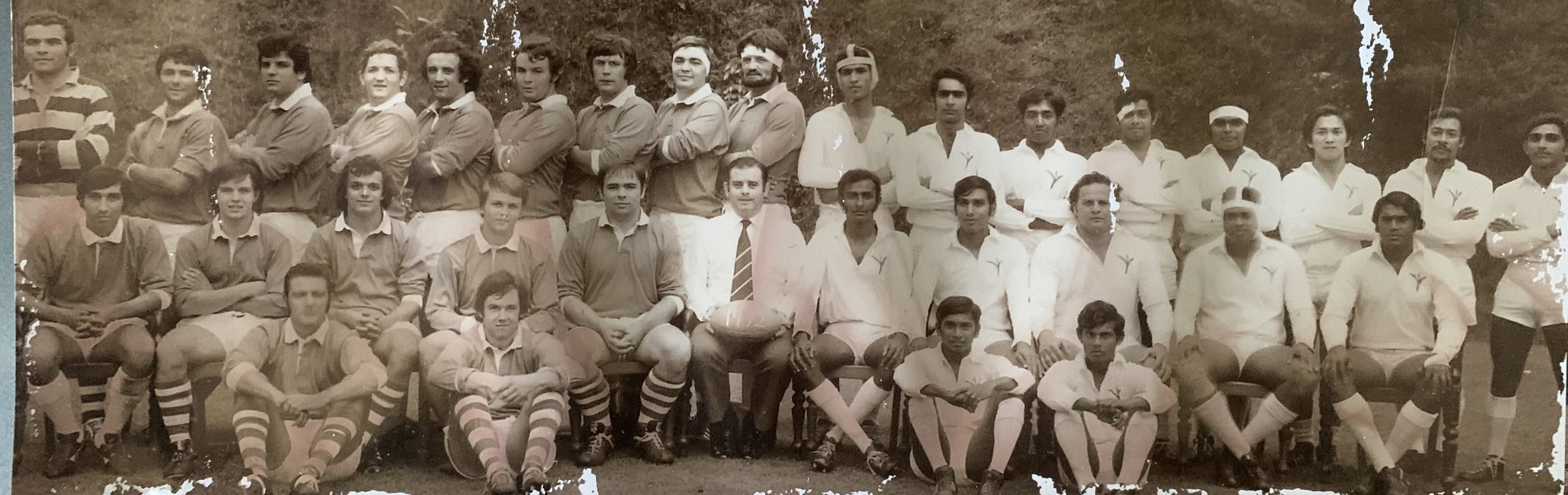
Chan Fa - standing third from the right, flanked by two Antonians Gavin Stevens and Farook Dole, when they played for the Up-country Ceylon team against the English Bosons.
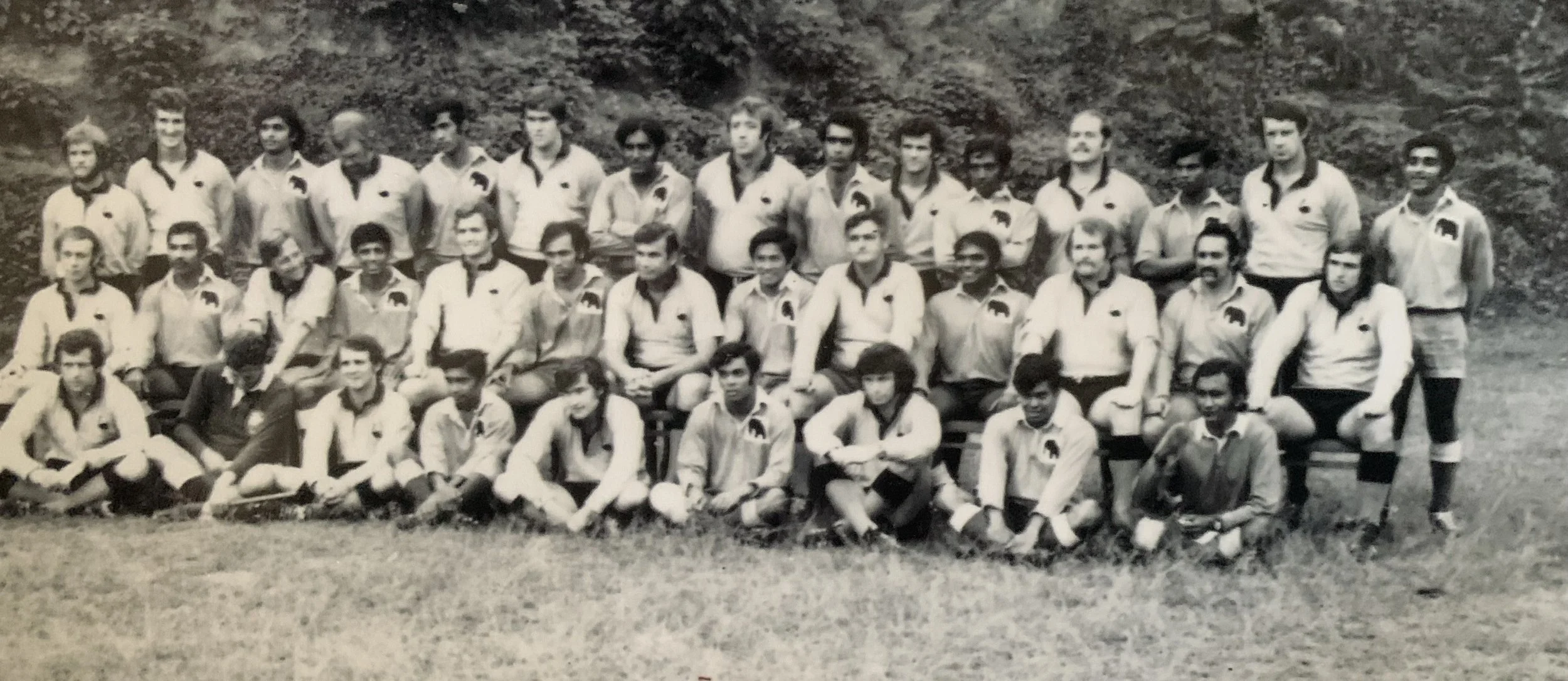
Chan Fa - seated in the centre with Gavin Stevens on his left. Standing fifth on the left is Abdul Kuthus, the 1968 Antonian Captain.
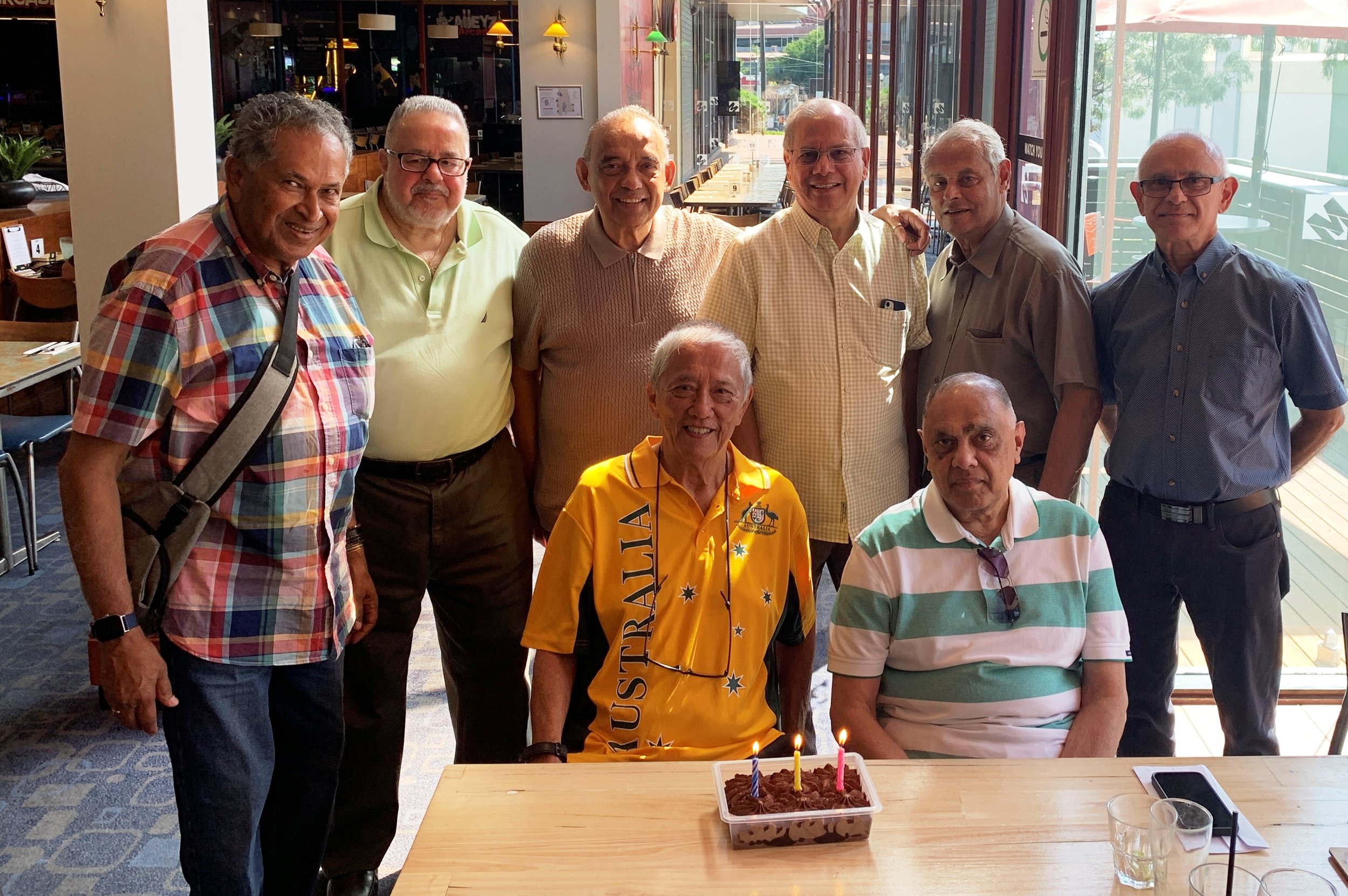
Chan Fa in Melbourne in December 2024. He is seated next to Michael Macky who was his Rugby Captain in 1965 and behind him, his 1966 Captain Paddy Guneratne at St. Anthony's College.
Alwin Shu, born 1955, descibed himself as an old boy of St Anthony's, on Facebook. He is now retired,married to a Sri Lankan lady and lives in Panadura. I tried to get more information, but was not successful. Given the name he is probably a relative of the Shoe Shop people.
My grateful thanks to the following, for providing information and photographs.
Winston Bayley.
Chris Drieberg.
Steve Morrell
Chan Fa Ching.
Mark Schrader.
Monte Holsinger
Patrick Berenger.
Cheers and thank you.
Trevor Berenger
Chiang Mai, Thailand - Not far from Yunnan Province, China!
THE SMOKERS CLUB
THE SMOKERS CLUB by Norman Thompson
Let me paint the picture.
The scene was set in the early 1960s in the College Villa boarding. A very small group of senior boarders, let’s call them “The SmokersPack”, threw up a big stink of not having a safe joint to pull a fag without being spied on by school authorities
by NORMAN THOMPSON - College Boarder 1953 until 1965, from Rainbow Cottage to Senior Villa dormitories
For the purpose of bringing you this article, I have included myself with this bunch of smokers as a bystander and was thus able to factually record what they were up to.
Let me paint the picture.
The scene was set in the early 1960s in the College Villa boarding.
A very small group of senior boarders, let’s call them “The Smokers Pack”, threw up a big stink of not having a safe joint to pull a fag without being spied on by school authorities. Smoking in current locations like the old score-hut or behind the Junior Villa dormitories or even behind the Music Room were deemed to be too risky. Detection by those in charge would mean “six of the best” or even expulsion from SAC, the school by the river they loved.
So, members of this group decided to address this important issue. At first, they were hard-up for suggestions. Then their leader (let’s name him Mr. A) later summoned the band to a meeting and a flush of a few ideas were discussed. A safe location had to be found soon.
No. 1 on the agenda was a careful survey be launched. One particular bathroom on the extreme left among the row of toilet units just outside the Villa study hall was earmarked for investigation. A feasibility study was initiated and a report in verbal form was discussed and a final decision was made to decommission the flushing system here so that it would remain motionless when future visitors who intend to drop their motions here will simply be turned away. The other motion was passed 8 to 0.
For no explained reason, this bathroom was larger than the rest. Its floor plan was of generous dimensions 7’ x 6’, whereas its neighbouring cousins offered only a confined space of say 5’x 3’ per stall.
Number 2 on the agenda for discussion was how to decommission the cistern (the chain variety). At first, the task in hand seemed a complicated factor. Various briefs surfaced and the prime mission was to dismantle this system which was fitted at an elevated point against the wall, and to then discard these offending parts as far away as possible. Instantly, these smokers became untrained demolishers. Regardless of any future consequences, their fertile minds got to work. Tummies began to rumble with enthusiasm when arms reached out to lift the cover off the flushing system and delve into the guts of it all. With no tools on hand and Bunnings being a long way off in another continent, brute strength and a portion of elbow grease along with a history of 2 to 3 daily servings of parippu since joining the boarding was called for. The floater-ball and arm were wrenched off by straining every sinew and tendon and the system was thus rendered inoperative. It was decided to leave the elderly squatting pan unchallenged. The smell of success sailed through the air. A weak voice from the back was heard to say “Lord, forgive us, for we know what we have done.” The boys were cock-a-hoop with delight. It is worth mentioning here that those offending parts later found their way to the site of the piggery under the cover of darkness.
Smokers usually entered their new environment in small groups. The popular brands of 3 Roses and Peacock were the fags of choice due to their affordability. A pause between each day was agreed upon to avoid plumes of smoke into the exterior too often that may raise the concerns of higher authorities. On days when stocks were low, sharing a single ciggy was undertaken by passing it around with extreme care in rugby-like fashion – from mouth to hand to mouth to hand to mouth and so on. On rare occasions when someone in line took a long drag, the “stick” came to an abrupt end – “No more light machang” was the call much to the annoyance of the others.
This space was not classified as a toilet anymore, but ready for use by smokers present and those emerging. It remained for its secondary purpose only for many years to come, and was acknowledged even by other senior students to be just that. It is worth mentioning that one bright spark introduced a ‘hansi puttuwa’ for the comfort of those inside. To this day, there is no evidence how this piece was delivered without arousing suspicion. The persistence and tenacity of this pack of boys should be acknowledged even to this day.
This is not fake news.