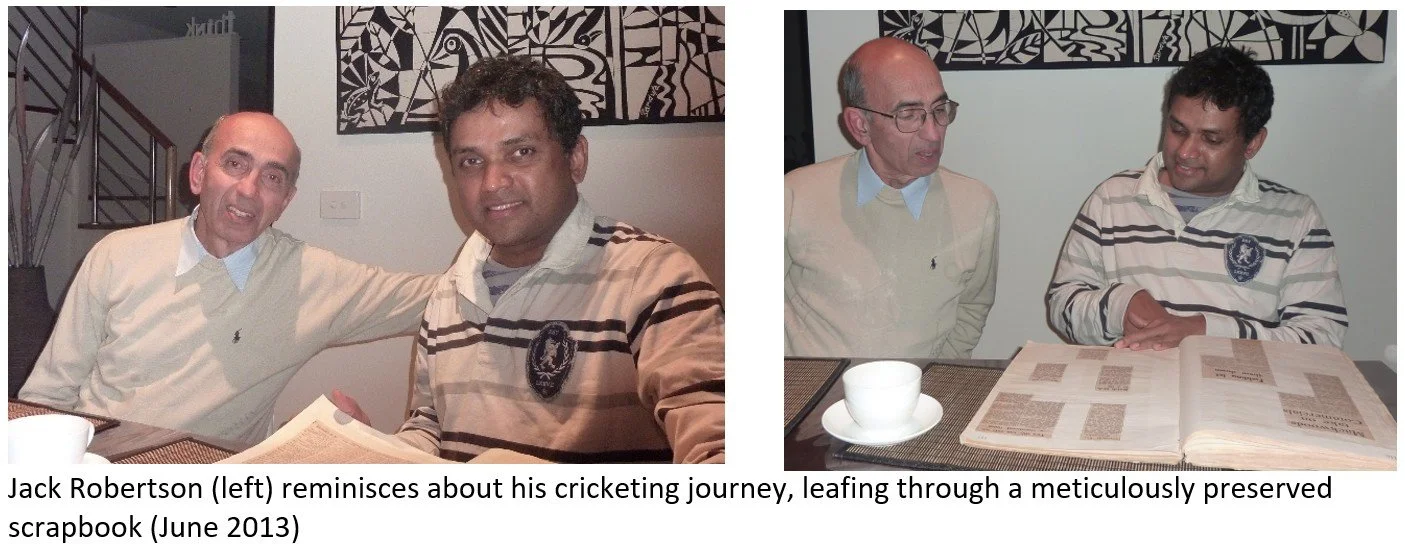
Widely regarded as the fastest bowler of his era, in both school and club cricket, Jack Robertson regularly had batsmen flinching in self-preservation. He was a genuinely fearsome prospect—an uncommon sight in Sri Lankan cricket at the time—and his raw pace and aggression fast-tracked him to national honours at the remarkably young age of 21.
Although Jack learned the fundamentals of fast bowling at St Thomas’ College, Matale, it was during his two-year stint at St Anthony’s College, Katugastota that he evolved into a complete fast bowler. It was no coincidence that his move came soon after Fr Aiden De Silva transferred from St Thomas’ Matale to take over as Principal in the mid-1960s.
“I joined St Anthony’s in 1968 at the wish of Fr Aiden,” Jack recalls.
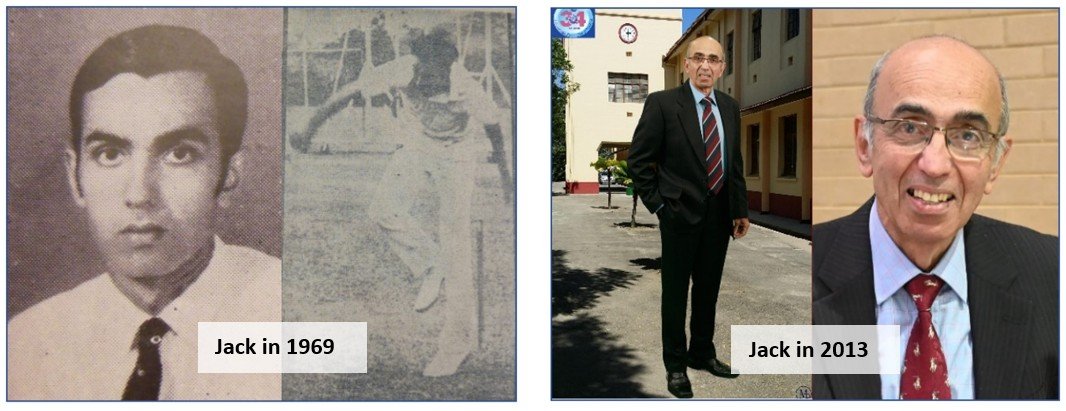
His first major breakthrough came at just 16, while still at St Thomas’, when he was selected to represent the National School Cricket Association XI against the touring London Schoolboys in 1966.
Jack enjoyed only moderate success in his first year at St Anthony’s College, finishing the season with 17 wickets, but he was already making batsmen uneasy, earning a reputation as the fastest bowler in school cricket at the time. Regular exposure to top school sides strengthened his belief that he truly belonged at the highest level.
His second year brought greater rewards, as he claimed 31 wickets in nine matches, highlighted by an impressive 5 for 31 against Dharmaraja. Even today, Jack speaks fondly of the impact college had on his life. “The two years I spent at St Anthony’s made me the person I am today. The lessons I learned as a boarder, and the support I received, transformed me from a shy young boy into a well-rounded, confident man.”
His team-mate and former Antonian skipper, Meri Guneratne witnessed Jack’s bowling at close quarters. “In my playing days of school cricket Jack was easily the best pace bowler I witnessed during that period. If Michael Holding was the Rolls Royce of fast bowlers in Test Cricket then Jack equally was the Rolls Royce of fast bowlers in school cricket during that era.” Recalls Meri.
“He had the classic run up and follow through. Largely due I believe due to his athletic prowess as the public schools 400 metre hurdles champion. The game that stands out in my mind was the 1968 match against Royal at Reid Avenue where we made around 138 all out and had Royal tottering at 27 for 5 at stumps on the first day. Jack had taken something like 3 for very little. It was the pace and movement that he generated that had the batsmen in all sorts of bother. He would pitch the ball on off stump to the right hander and the ball would move past the leg stump. Similarly, if he pitched on leg stump, he could move the ball outside off stump and that at genuine pace. I was fielding at first slip so could clearly observe this. On crossing ends in between overs, I overheard the Royal batsmen commenting, “this guy is really quick”, continued Meri.
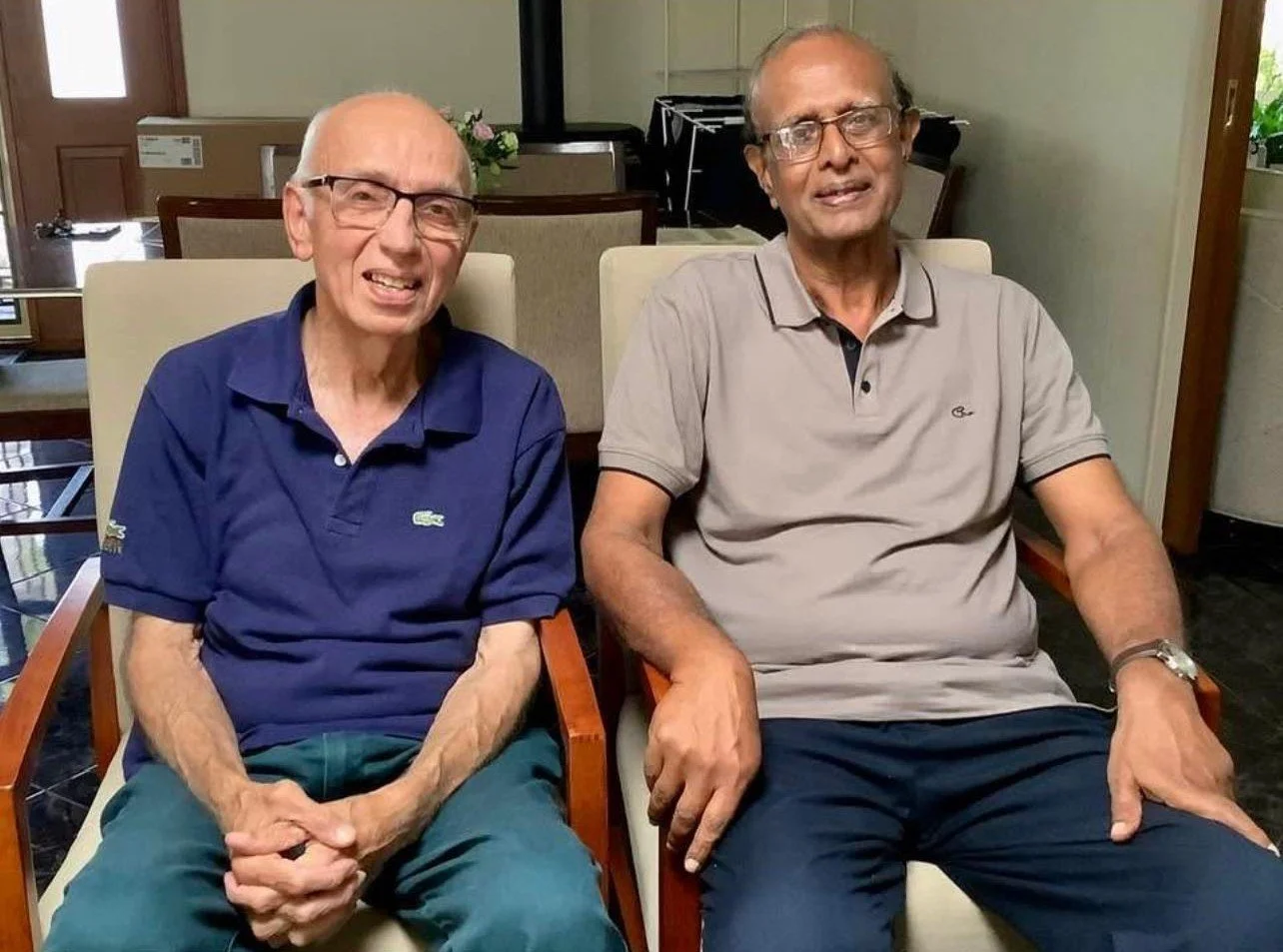
“A long time ago we were fast and furious, terrorising batsman from both sides of the wicket.”- Antonian pace duo from 1968, Jack Robertson (left) and Bernard Balaraj pictured recently.
Jack left a lasting impression in the two Big Matches he played. In 1968, he played his part with the ball in an emphatic innings victory over Trinity at Katugastota. The following year at Asgiriya, he was again at the centre of events, this time in a far more dramatic fashion, when he was instrumental in bringing down Trinity’s Nihal Marambe.
“As the game was meandering along, I decided to bowl some short-pitched stuff to make things happen. The delivery that struck Nihal flush on the mouth was actually heading straight for the neck and was simply too quick for his liking.”
Marambe collapsed to his knees and had to be carried off the field by Antonian players. “When we were halfway down to the pavilion, the Asgiriya crowd turned on us, hurling stones and boos, which I suppose was mainly directed at me.”
When play resumed with the new batsman, Weerasinghe, Jack admits he was too disturbed to bowl at full pace. “I ended up offering a real ‘lollipop’ and, to my amazement, the nervous and shaky Weerasinghe missed it completely and was clean bowled.”
A couple of days after the match, Jack made it a point to visit Trinity College to inquire about Marambe’s condition. Although he was unable to meet him, the gesture was warmly received, with the Trinitians deeply impressed by Jack’s sportsmanship.
No sooner the school cricket season was over in 1969, Jack was signed on by the Colts Cricket club to play ‘first-class’ cricket. He catapulted to the top in only his first year of cricket at this level, emerging as one of the best and most feared fast bowlers in Sri Lankan cricket. A leading newspaper reporter had this to say “If there is a distinct quality in Robertson’s bowling, it is his sheer menacing hostility. So much so that even when runs are being scored off him, he has never really been mastered. He has that uncanny knack of producing that unplayable delivery, the ball that lifts off a good length, that no batsman has been totally comfortable against him”
Jack’s long-held ambition of representing the national team was realised at just 21, when he was selected in January 1971 for the Anura Tennakoon–led All-Ceylon side that toured South India for the Gopalan Trophy. On the eve of the tour, he struck peak form, claiming a superb match haul of 12 for 65 against BRC—exactly the confidence boost the selectors would have hoped for. During the tour, Jack came up against future greats such as Sunil Gavaskar and Mohinder Amarnath, and he more than justified his selection with a series of creditable performances.
A year later, however, Jack made a life-changing decision. At just 22, he chose family over a burgeoning cricket career and migrated to Australia with his parents and six siblings. His father, the last of the family to remain in Ceylon, had long been determined not to leave his homeland, but worsening conditions eventually compelled him to join the rest of the family Down Under. Jack turned out for Prahran for a season, but mounting work commitments soon forced him to step away from the game, bringing a promising chapter of his cricketing journey to a premature close.